Roll up banner sizes: standard widths and which one to order
Roll up banner sizes explained: 85×200, 100×200, 120×200 and wider, what changes with width, material choices, artwork setup and real carton packing data.
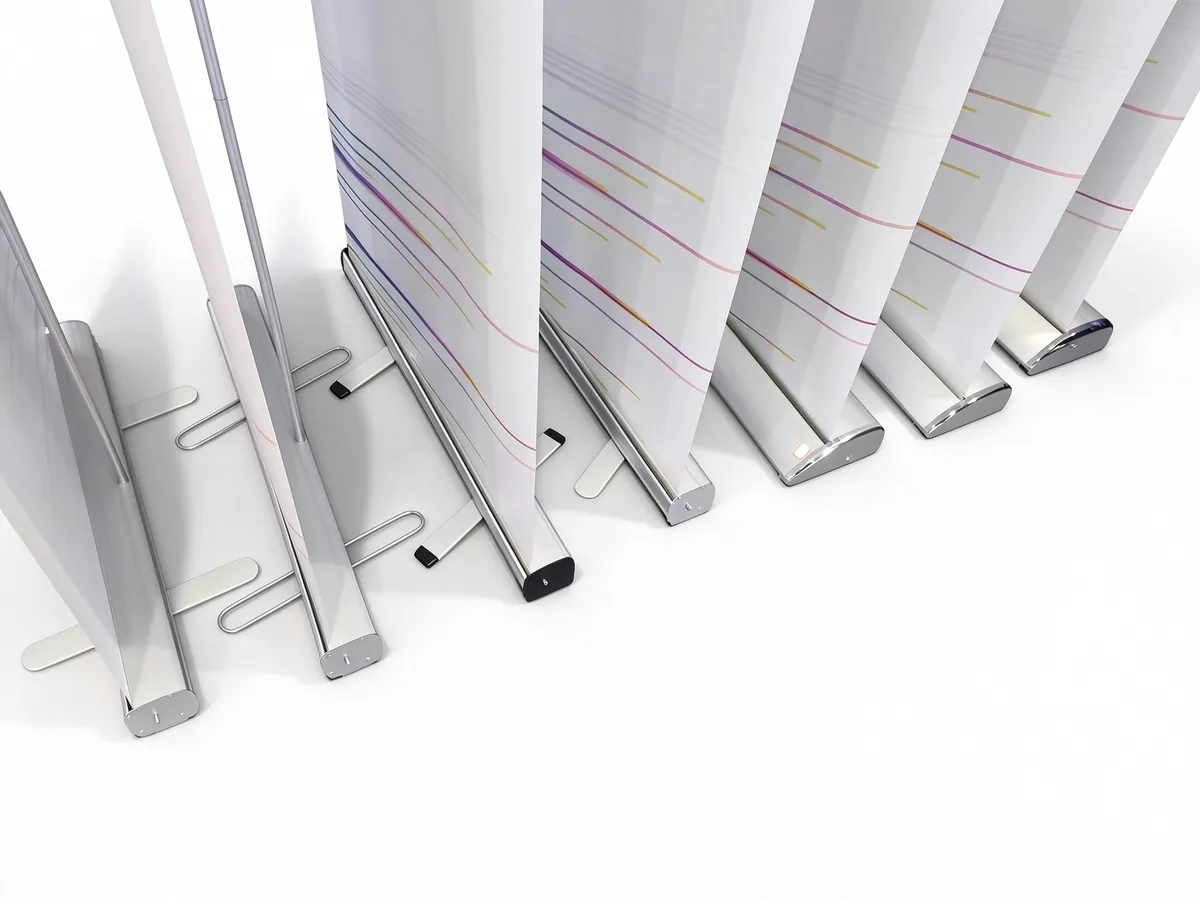
Short answer: 85 × 200 cm and 80 × 200 cm are the volume sizes worldwide — they fit a shop entrance, a booth wall and a car boot. Step up to 100 × 200 or 120 × 200 when the banner must carry more copy or stand at the back of a booth. Width changes what fits on the graphic; 200 cm height is the constant that makes a roll-up read as a roll-up.
Roll-ups are the simplest product in the display family to over-think. The height is effectively fixed, the width is a choice about content, and everything else — cassette, pole, print media, bag — follows from those two decisions.
Standard roll up banner size chart
| Graphic size | Best for | Notes |
|---|---|---|
| 60 × 160 cm | Table-top and compact retail | Rarely stocked; special order |
| 80 × 200 cm | Shop entrances, booth walls | Our TX-RU80 standard |
| 85 × 200 cm | The EU de facto standard | Interchangeable with 80 × 200 in most quote systems |
| 100 × 200 cm | Wider graphics, product line-ups | Step-up size for retail chains |
| 120 × 200 cm | Booth back walls, media walls | Needs a firmer cassette |
| 150 × 200 cm | Stage-side and event signage | Two-person setup |
| 200 × 200 cm | Statement piece, photo walls | Freighter's favourite, designer's risk |
Two conventions worth knowing: 85 cm is the European standard because it matches the graphic width of older cassette tooling; 80 cm dominates export programmes because it nests better in cartons. Functionally they are the same product.
What actually changes with width
- Content capacity. An 80 cm graphic holds a logo, a headline and three bullet points. A 120 cm graphic holds a product family. Do not buy width you have not filled with content.
- Stability. Wider cassettes need stiffer extrusions and a wider stance, or the banner rocks on hard floors.
- Cost per unit rises with width, but not linearly — the cassette, not the print, is the cost driver.
- Freight rises in steps, not smoothly, because cartons are built around standard widths. Mixed-width orders waste carton space.
Height: why 200 cm won
Two metres puts the message at standing eye level while the cassette stays at the floor, where the weight belongs. Shorter heights (150 cm) exist for table-top use; taller (250 cm +) needs a wider stance to stay upright and stops being a one-person setup. For most buyers the only height decision is "200", and the real choice is width.
Print media: PP film or anti-curl textile
| PP film | Anti-curl textile | |
|---|---|---|
| Cost | Lower | ~15 – 25% higher |
| Curl at edges | Tends to curl over time | Stays flat |
| Look | Glossier, poster-like | Fabric matte, premium |
| Durability across campaigns | Short-cycle | Multi-season |
| Best for | One-off promotions, price-led buys | Distributor programmes, repeated events |
Anti-curl textile is the safer recommendation for anyone reselling — the curl complaint is the single most common roll-up after-sales issue, and textile eliminates it.
Single-sided or double-sided?
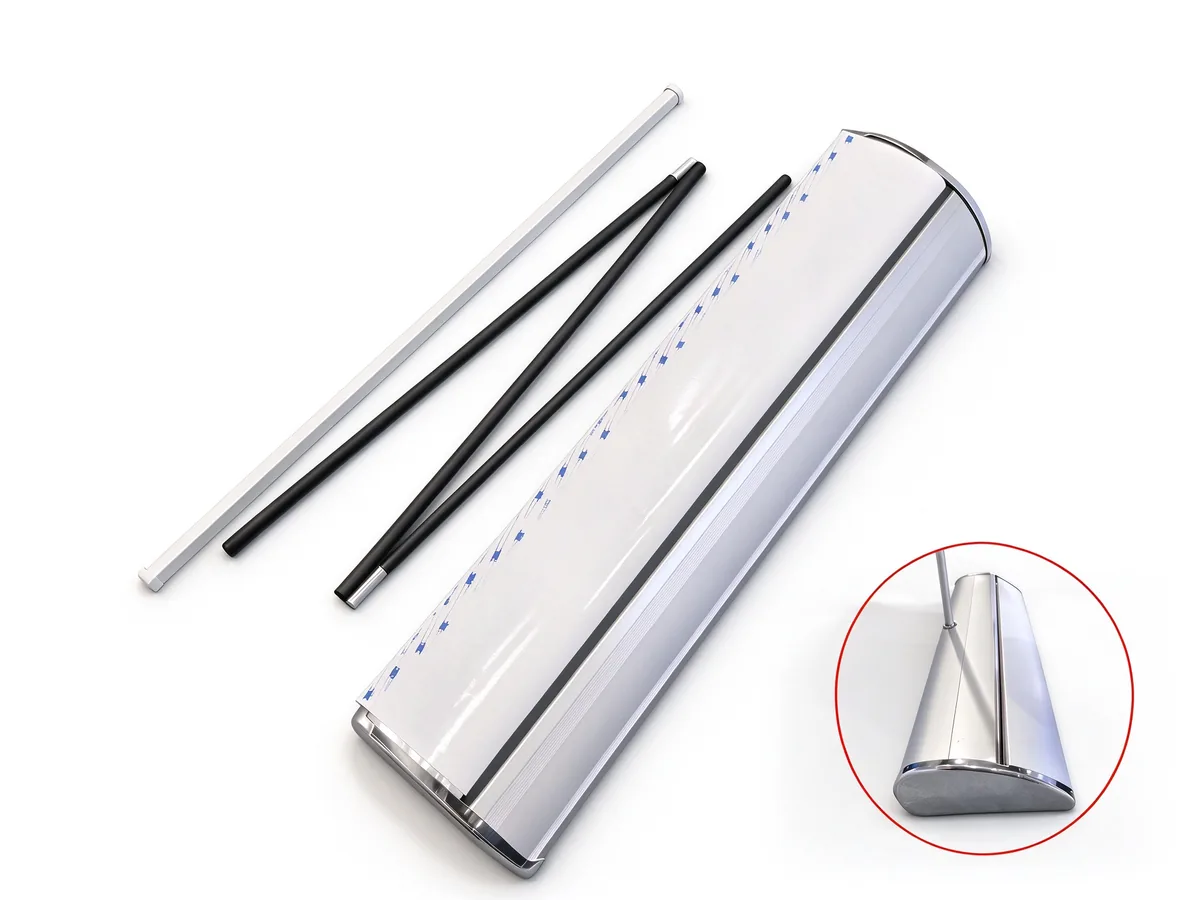
Double-sided roll-ups exist — a wider cassette carries graphics back to back. They make sense for aisle positions and room dividers. They roughly double the print cost, add weight, and need a level floor. For entrance and wall placement, single-sided plus a wall behind it is the rational choice.
Artwork setup, done once, correctly
- Build at final size — 85 × 200 cm means an 85 × 200 cm artboard, plus 2 – 3 mm bleed.
- Resolution 100 – 150 dpi at final size. More is wasted; less shows at 50 cm.
- Keep the top 30 cm quiet. The top bar and the pole hook live there.
- Bottom 20 cm is the visible curl-risk zone — no small text below it.
- CMYK, fonts outlined, Pantone refs for brand colours.
Packing and freight: real numbers
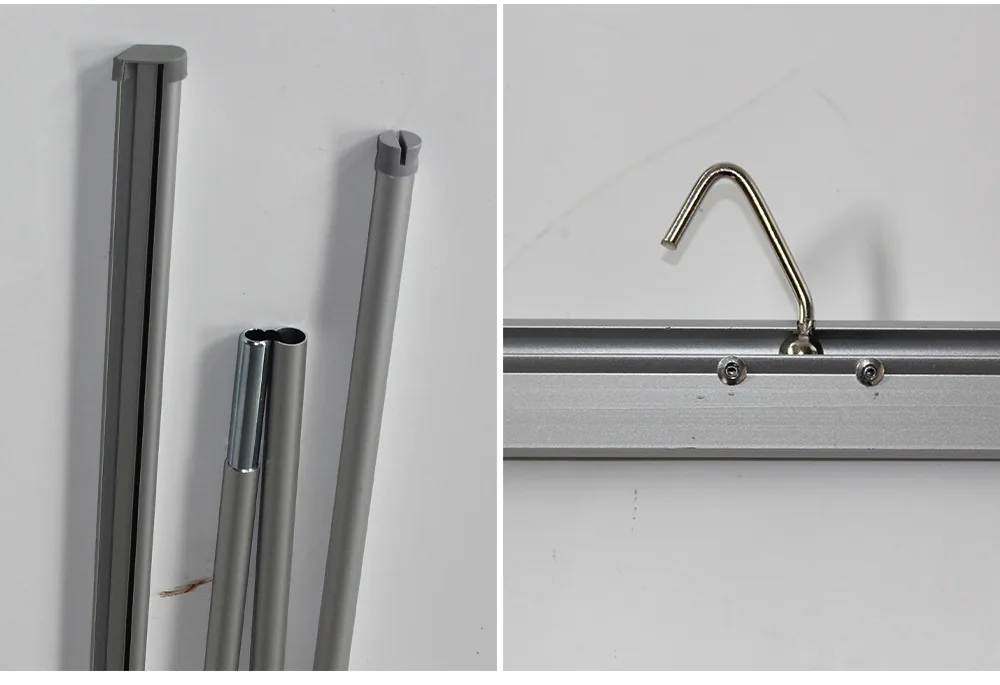
Our TX-RU80 80 × 200 cm set — cassette, pole, printed graphic and carry bag in one box:
| Item | Value |
|---|---|
| Sets per carton | 6 pcs |
| Carton size | 90 × 32 × 32 cm (0.092 CBM) |
| MOQ | 100 sets |
| Sample | Printed sample in 7 days |
A 20GP container takes roughly 300 cartons ≈ 1,800 sets before weight becomes the limit. Complete sets are heavier than flag poles, so weight — not volume — usually caps the container first.
Choosing for a distributor programme
Stock two widths, not five: 85 × 200 for the EU volume market and 100 × 200 for step-up orders. Offer media choice (PP vs textile) as the upsell. Everything else is a special order that ties up cash. The full model spec is on the roll-up banners category, and our FAQ page covers MOQ, sampling and lead times.
FAQ
What is the most common roll up banner size?
85 × 200 cm in Europe, 80 × 200 cm in export programmes. They are functionally the same banner; the difference is cassette tooling convention.
Is a wider roll-up banner better?
Only if the content needs it. Width without content reads as empty space, and wider cassettes cost more and travel worse. Buy the width your artwork fills.
Can I use one artwork for 80 cm and 120 cm banners?
No — proportions differ and the layout will stretch. Rebuild the artboard at each final size; the 30 minutes saves a reprint.
How long does a roll-up banner last?
The hardware survives years of trade use; the graphic is the consumable. PP film lasts a campaign or two, anti-curl textile several seasons. Order spare graphics per cassette rather than spare cassettes.
Do roll-up banners ship with a bag?
Yes — every set we ship includes a padded carry bag, and the carton is designed to protect the cassette rail, which is the part that dents in transit.