Double sided flag printing: how it works and when to pay for it
Single-layer vs three-layer double-sided flag printing: mirror images, block-out layers, artwork requirements, weight penalties and when each method is worth the cost.
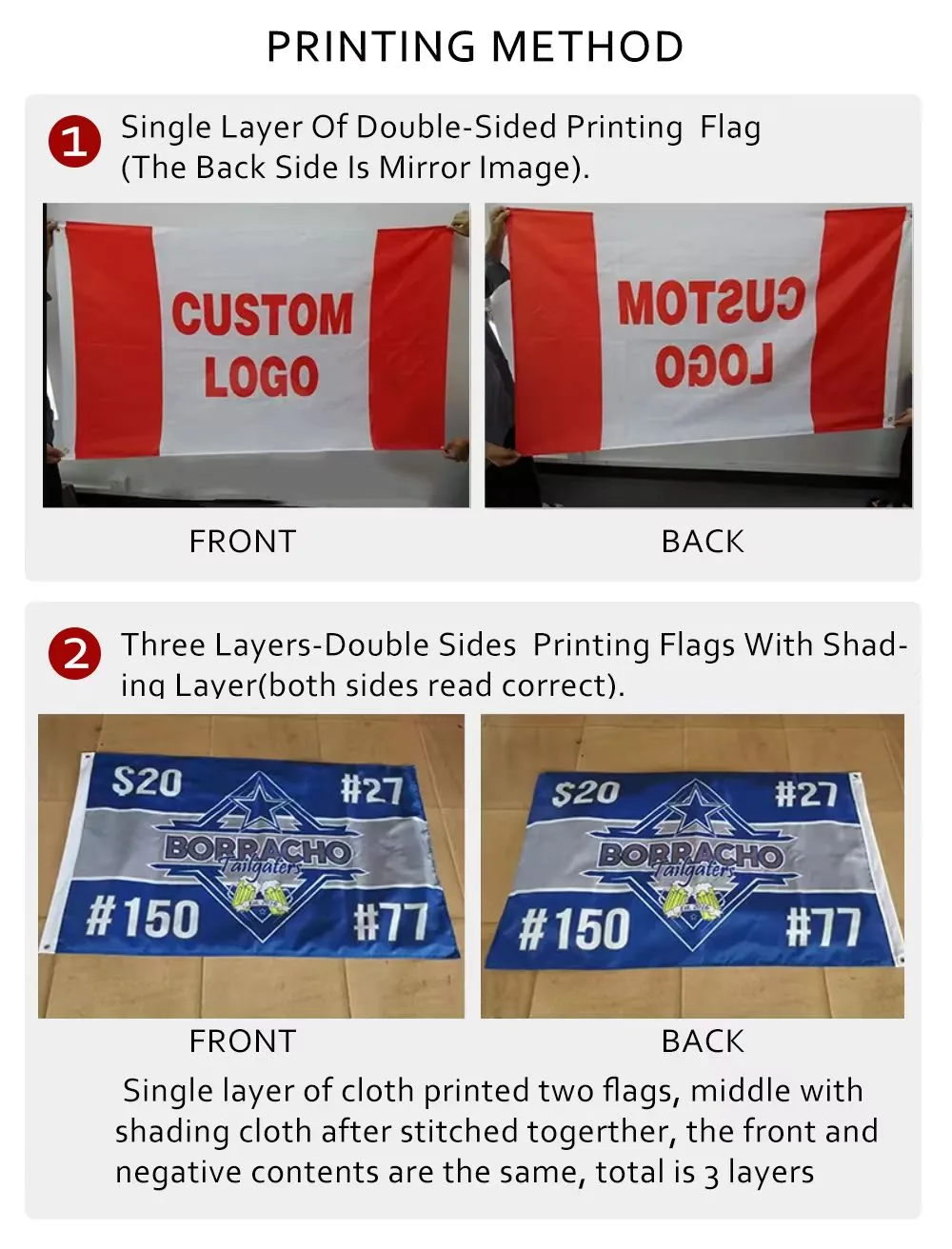
Short answer: there are two ways to print both sides of a flag. A single printed layer shows a mirror image on the back — readable in silhouette, reversed up close. A three-layer build prints two faces and stitches a black-out cloth between them, so both sides read correctly at the cost of extra fabric, weight and lead time. Pay for the second only when people genuinely read your flag from both directions.
Most "double-sided" flags quoted cheap are single-layer. That is not a scam — it is a different product — but buyers who expect a correct-reading back and receive a mirror are the most common complaint in printed flags. Here is the difference, and how to specify it.
The two construction methods
Method 1 — single layer, printed through. One layer of knitted polyester, dye-sublimation printed so the ink penetrates most of the way through. The front reads correctly; the back shows the same artwork mirrored, at 80 – 90% of the front's intensity. Cheapest option, lightest flag, one print pass.
Method 2 — three layers with a shading layer. Two printed faces and an unprinted black-out cloth in the middle, stitched or bonded together. Both sides read correctly and no light shows the reverse artwork through. Costs more fabric, an extra print pass and a sewing operation; the finished panel is noticeably heavier.
| Single layer | Three layer | |
|---|---|---|
| Back reads correctly | No — mirrored | Yes |
| Show-through of reverse artwork | Visible, reversed | None |
| Relative weight | 1× | ~2.5 – 3× |
| Wind load on pole and base | Normal | Higher — upsize the base |
| Best for | Roadside flags, volume programmes | Entrances, indoor, premium events |
When single-sided is enough
- The flag rotates on a spindle, so the "back" alternates constantly and neither side dominates.
- The site is read from one direction — a forecourt flag facing the road, a queue-side banner.
- The programme is volume retail where every 10 cents per unit is felt at container scale.
- You accept silhouette readability: from 20 m a mirrored back still communicates shape and colour.
Most roadside feather flags worldwide are single-layer, and nobody reads the back at 60 m anyway.
When to specify three-layer double-sided
- Entrances and walkways where foot traffic passes both sides at close range.
- Indoor and exhibition use, especially under back-lighting, where show-through is ugly.
- Premium retail where the flag is photographed up close for social media.
- Fixed-mount flags on buildings, where the back never rotates away.
Artwork requirements for double-sided
Three-layer construction gives you a freedom single-layer does not: the two faces can carry different artwork — pricing on one side, branding on the other. To keep the print file clean:
- Vector first. AI or PDF with fonts outlined. Photos embedded at 150 dpi minimum at final size.
- CMYK, with Pantone references for brand-critical colours so we can match on the production floor.
- Build each face at final flag size, mirroring handled at our end — do not pre-mirror your back face.
- Keep text 10 cm from edges; the sleeve and pocket consume the outer margin.
- One bleed panel per face, labelled FRONT and BACK in the file name, not in the artwork itself.
For single-layer jobs, design the front knowing it will be mirrored on the back — asymmetric layouts and directional arrows look wrong from behind.
The weight and wind penalty
A three-layer panel at 4.5 m roughly triples the fabric mass of a single-layer flag. That matters twice: it loads the pole and base harder in wind, and it changes the flag's drape — stiffer, fuller, slower to dry.
Practical consequences: pair a double-sided 4.5 m flag with a filled tank rather than a bare cross base, and favour 130 g faces over 110 g so the panel does not distort where the layers are stitched. Our base pairing table accounts for sail area — read it before you upsize the print, not after the claim.
Where the cost actually goes
Double-sided pricing carries: a second sublimation pass, the block-out cloth, the lamination or stitching operation, and slower finishing. What it does not change: the pole, the base and the freight carton — the set still packs into the same 35-per-carton pole boxes, so at container scale the delta per unit shrinks further.
How we quote it
Send the same seven lines as any flag enquiry — size, quantity, fabric, print sides, pole, base, destination port — and note "double-sided, 3-layer" explicitly. Quotation comes back in 12 working hours with packing data; printed samples ship in 7 days. Start at the contact page or browse the beach flag pole range first.
FAQ
Is a double-sided flag worth the extra cost?
If the flag is read from both directions at close range — entrances, indoor, exhibitions — yes. If it faces traffic from one side, single-layer delivers 95% of the effect for less.
Can the two sides have different designs?
Yes, with three-layer construction. Each face is printed separately, so front and back artwork can differ entirely. Single-layer flags cannot: the back is always the mirrored front.
Does double-sided printing make the flag heavier?
Noticeably — the shading layer roughly triples the panel's fabric mass. Upsize the base accordingly and expect a stiffer drape.
Why is the back of my flag mirrored?
Because it was printed on a single layer and the ink shows through from behind. That is method 1 above. If you need a correct-reading back, specify three-layer double-sided at order time — it cannot be retrofitted.
What file format do you need for double-sided artwork?
AI or PDF, vector, fonts outlined, CMYK with Pantone references for brand colours. Supply two labelled panels — FRONT and BACK — at final size. Full artwork rules are in the guide above.