Flag base types explained: cross, water bag, square tank and ground spike
Which flag base for which surface and pole length: cross base, fillable water bag, square tank and ground spike, with real weights, carton data and failure modes.
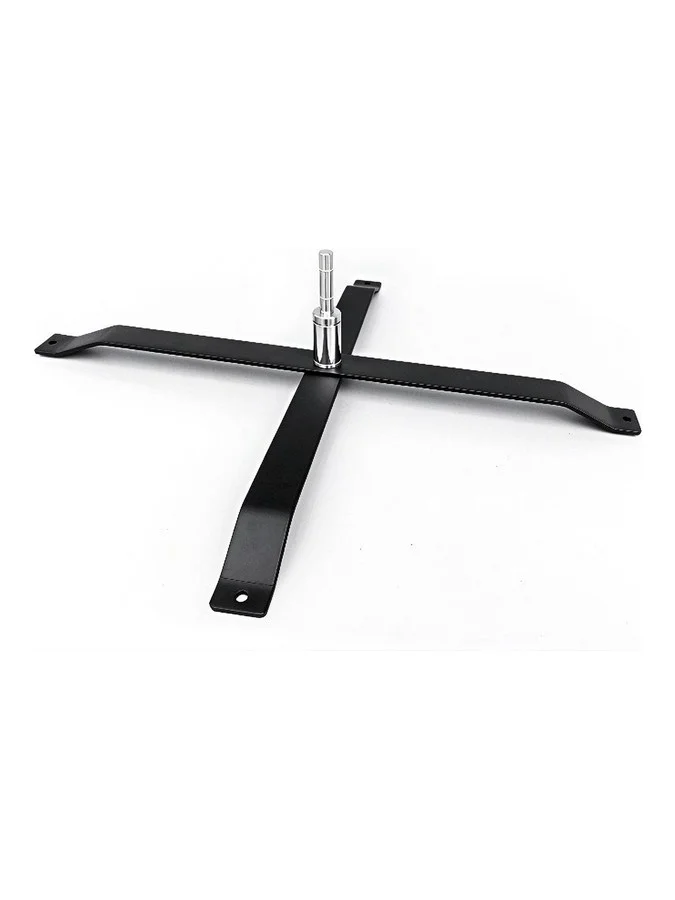
Short answer: match the base to the surface, not to the pole. Cross base on paving and indoor floors, water bag where you need cheap ballast that ships empty, square tank where the base is visible and has to look finished, ground spike only in soil, grass or sand. Above 4.5 m, add real weight — a bare cross base outdoors is not enough.
A beach flag is a lever. The pole multiplies whatever the wind does to the flag, and the base is the only thing resisting it. That is why the same 4.5 m flag that behaves perfectly on a sheltered forecourt will lie down on a coastal corner site with an identical base.
The four base types we make
| Base | Model | Best surface | Pole range | Unit weight | Packing |
|---|---|---|---|---|---|
| T3 flat iron cross, 80 cm | TX-CB80 | Paving, concrete, indoor floors | 2.8 – 4.5 m | 2.83 kg | 6 per carton |
| Fillable water bag, 10 L | TX-WB10 | Any hard surface, events | 2.8 – 3.4 m | 10 kg filled | 100 per carton, 39 × 39 × 20 cm |
| Square water / sand tank | TX-SB40 | Forecourts, visible sites | 3.4 – 5.6 m | 7.5 kg empty | Nested or single carton |
| Round ground spike, 51 cm | TX-GS51 | Soil, grass, sand | 2.8 – 4.5 m | 0.95 kg | 20 per carton |
Cross base: the default on hard ground
The flat iron cross base is what most distributors ship with a flag set. Our T3 version spans 80 cm, weighs 2.83 kg and carries a 360° rotating spindle — the detail that decides whether the flag lasts a season or a month.
On a fixed base, the flag twists around a stationary pole in every gust. The sleeve grinds against the pole, the hem frays, and the print cracks along the fold lines. A rotating spindle lets the whole flag turn with the wind instead, so the same fabric lasts dramatically longer.
Two practical notes: the 80 cm span matters more than the weight on paving, because leverage comes from the footprint; and a cross base on a slope needs shimming, or the pole leans and the flag reads crooked.
Water bag: cheapest ballast, shipped empty
A 10 L bag travels flat and becomes roughly 10 kg of ballast on site. That is the whole commercial argument: you are not paying to ship water across an ocean.
- Freight: empty bags pack 100 per carton at 39 × 39 × 20 cm, so a pallet holds thousands.
- Setup: fill on site from a tap or a bottle; four stabilising feet spread the load.
- Limit: it is a light-duty base. One flag up to 3.4 m in moderate conditions, indoors or in shelter.
Fill it with sand instead of water and you get more mass per litre, at the cost of not being able to empty it easily at the end of a campaign.
Square tank: when the base is part of the display
A fillable square tank costs more than a bag and less than a cast base, but it is the only option that looks deliberate on a forecourt. Flat footprint, central spindle, water or sand fill; it does not slide on paving and it does not read as a temporary fix.
This is the base we quote for fuel stations, dealership front lines and supermarket car parks — sites where the customer's brand standards apply to the base, not just the flag. Our TX-SB40 ships empty at 7.5 kg and takes water or sand on site.
Ground spike: only where there is soil
A 51 cm steel spike is the lowest-cost way to stand a flag: drive it in with a foot, no base plate, no ballast. It is also the base most often used in the wrong place.
- Works: grass verges, golf courses, sports fields, beaches, garden centres, event fields.
- Fails: paving, concrete, decking, gravel over hardcore, and loose dry sand.
- Wind note: on sand or in strong wind, one spike is not enough for a 4.5 m pole. Use two flags anchored to each other, or move to a weighted base.
Our TX-GS51 is 51 cm long at 0.95 kg, packed 20 per carton.
How much weight does a flag actually need?
There is no universal number, because sail area, pole length and exposure all move together. The working rule from our line:
| Pole | Sheltered (indoor, courtyard) | Normal outdoor | Exposed (coast, corner, open lot) |
|---|---|---|---|
| 2.8 m | 10 L bag | 10 L bag or cross base | Cross base + 5 kg |
| 3.4 m | Cross base | Cross base + 5 kg | Square tank, filled |
| 4.5 m | Cross base + 5 kg | Square tank, filled | Tank + extra weight, 130 g fabric |
| 5.6 m | Tank, filled | Tank + extra weight | Not recommended without engineering |
Two cheap improvements beat buying a heavier base: switch to 130 g fabric (less flogging, less load) and keep the flag one size shorter on exposed sites.
Surface decision table
| Surface | Base | Watch out for |
|---|---|---|
| Concrete, paving, tiles | Cross base or square tank | Wind funnelling between buildings |
| Indoor showroom, mall | Cross base or water bag | Ceiling height, sprinkler heads |
| Grass, soil | 51 cm spike | Soft ground after rain |
| Sand, beach | Spike, deep, or weighted base | Loose dry sand holds nothing |
| Gravel over hardcore | Square tank | Spike will not penetrate |
| Sloping ground | Cross base with shims | Pole lean reads as poor quality |
Failure modes we see in claims
- Bent spindle — pole used above the base's rating, or a 5.6 m pole on a 3.4 m base.
- Cracked tank seam — filled with sand and dropped, or overfilled and left in sun.
- Bag split — dragged across paving instead of lifted.
- Flag sleeve torn, base fine — fixed spindle, no rotation. The base was not the problem.
- Spike bent at the top — driven in with a hammer instead of a foot, or hit a stone.
If you tell us the surface, the pole length and roughly how exposed the site is, we will quote the base with the flag rather than after the claim. Sizing logic for the pole itself is in the beach flag sizes chart.
FAQ
What is the best base for a beach flag?
For hard surfaces, an 80 cm cross base with a rotating spindle up to 4.5 m, and a filled square tank above that. For soil, grass or sand, a 51 cm ground spike driven fully in.
How much weight do I need for a 4.5 m flag?
Roughly 10 – 15 kg of ballast in normal outdoor conditions, more on an exposed site. A bare 2.83 kg cross base is fine indoors or in a sheltered courtyard, not on a coastal forecourt.
Can I use a water bag base on grass?
Yes, but it is a compromise: the bag spreads load over a small area and grass is soft. A spike holds better in soil, and a tank or cross base is better again on any hard surface.
Why does the rotating spindle matter?
It lets the flag turn with the wind instead of twisting around a fixed pole. That single part is the difference between a sleeve that lasts a season and one that frays in weeks.
Do bases ship filled?
No. Bags and tanks always ship empty; filling happens on site. That is what keeps freight affordable — a filled 10 L bag weighs 10 kg more per unit, on every unit, across every ocean.
Do you supply bases with the flags or separately?
Both. Most distributors order bases and poles together from the bases & accessories range and flag bodies separately, because bodies are the part that gets reprinted each season.