Custom beach flag price: the five factors that move your quote
Why custom beach flag prices vary so much between quotes: size, fabric weight, print sides, pole material and base, plus freight maths and the hidden costs buyers forget.
Short answer: no factory has a fixed beach flag price list, because five variables move the number: flag size, fabric weight, print sides, pole material and base type. Quantity sits on top of all five — the same 4.5 m set that is expensive at 50 pieces becomes cheap per unit at 5,000. Send those five details plus your destination port and you will get a real FOB quote, not a guess.
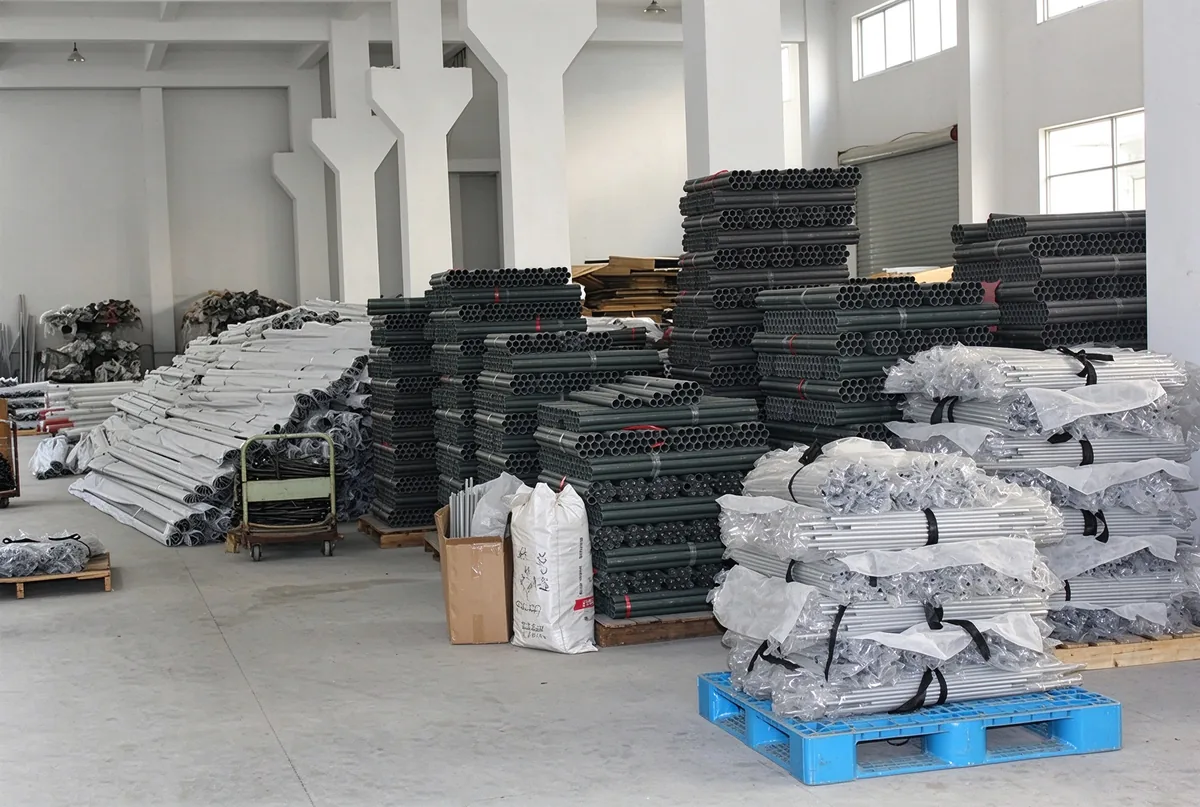
We manufacture these sets in our own plant in Linyi, and the most common first email we receive is "how much for a beach flag?" — with no size, no quantity and no destination. This page is what we send back, so buyers can see where the money actually goes before they compare quotes.
Why there is no fixed price list
A beach flag set is not one product; it is a system of flag body, pole, base and print spec. Two 4.5 m sets can differ by more than a factor of two in cost depending on the choices below. Any supplier who answers "how much?" without asking five questions is quoting a spec you did not ask for.
A quoteable enquiry contains:
- Flag size (or pole length) and shape — feather, teardrop or rectangle
- Quantity per size, and whether spare bodies are included
- Fabric weight — 110 g or 130 g knitted polyester
- Print — single-sided or double-sided with a block-out layer
- Pole — fibreglass, aluminium or carbon, and the number of sections
- Base — cross, water bag, square tank or spike
- Destination port or door address — FOB, CIF and DDP are different numbers
Factor 1: flag size — the fabric equation
Fabric is the single largest material cost, and consumption scales with the printed area, not with the pole length. The standard feather flags work out like this:
| Pole | Feather flag | Printed area | Relative fabric |
|---|---|---|---|
| 2.8 m | 50 × 200 cm | 1.0 m² | 1.0× |
| 3.4 m | 60 × 240 cm | 1.44 m² | 1.44× |
| 4.5 m | 70 × 340 cm | 2.38 m² | 2.38× |
| 5.6 m | 80 × 410 cm | 3.28 m² | 3.28× |
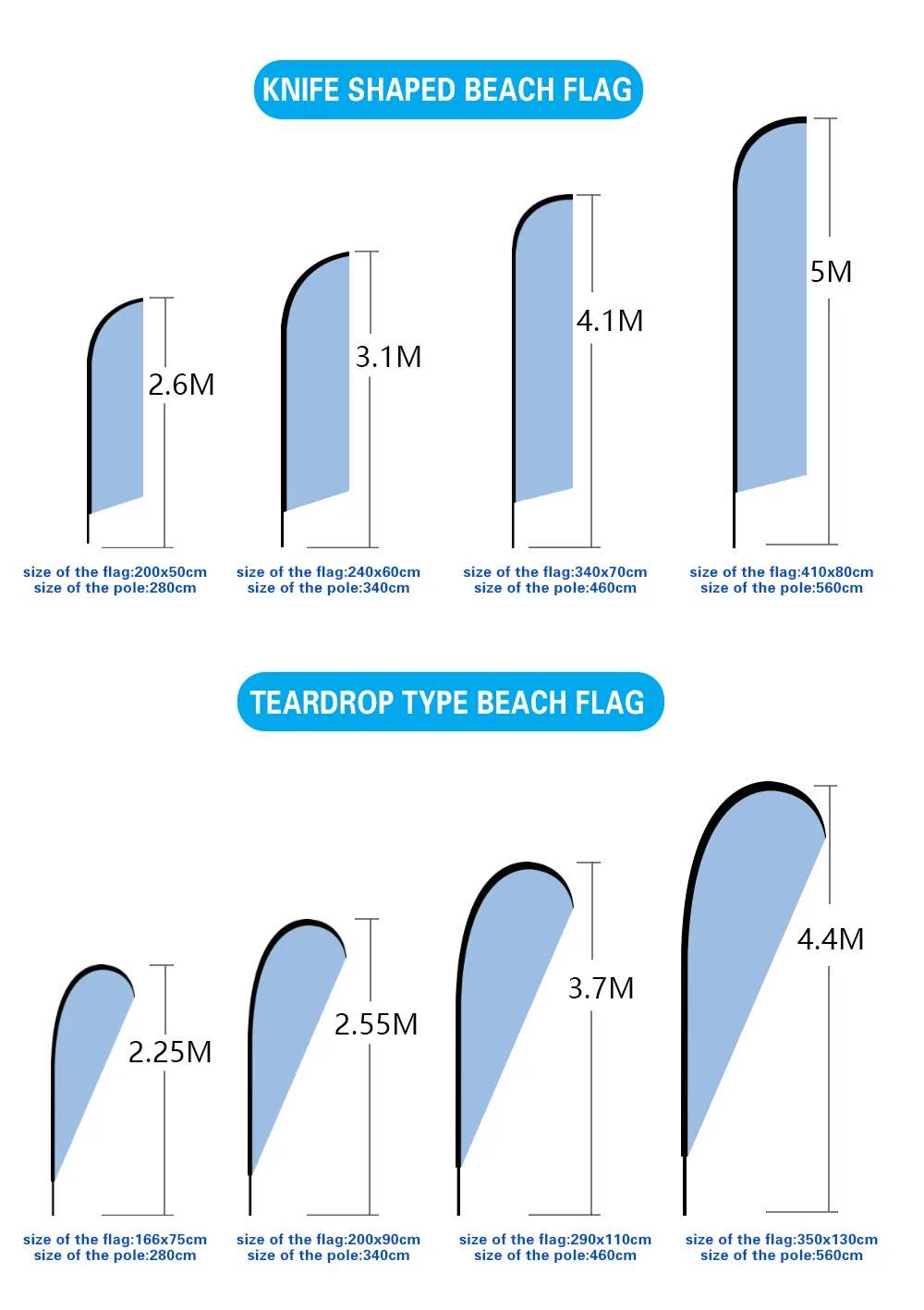
A 5.6 m flag uses more than three times the fabric of a 2.8 m flag on a pole that is only twice as long. That is why the jump from 4.5 m to 5.6 m feels expensive per unit while the jump from 2.8 m to 3.4 m barely registers. Teardrop shapes add another 5 – 8% on top of the same pole length because the body is wider — the shape comparison is covered in our feather vs teardrop guide.
Factor 2: fabric weight — 110 g vs 130 g
Both weights are knitted polyester printed by dye-sublimation. The differences that matter:
- 110 g — the volume option. Lighter, cheaper, dries fast. Right for short campaigns and one-season retail.
- 130 g — heavier hand feel, holds shape longer, resists print cracking where the flag folds. We recommend it for coastal or windy sites and for flags that will be re-used across seasons.
The price gap between the two is real but modest next to the size effect. If a quote looks too cheap, the fabric weight is the first place the saving is hiding.
Factor 3: print sides
Single-sided print shows a mirror image through the back — fine for most outdoor use, and it keeps weight and cost down. Double-sided print needs a block-out layer laminated between two printed faces, which adds a print pass, a sewing operation and meaningful weight.
Where the flag is approached from both sides, or lit from behind, double-sided earns its cost. The full breakdown — including the three-layer construction — is in our double-sided flag printing guide.
Factor 4: pole material and sections
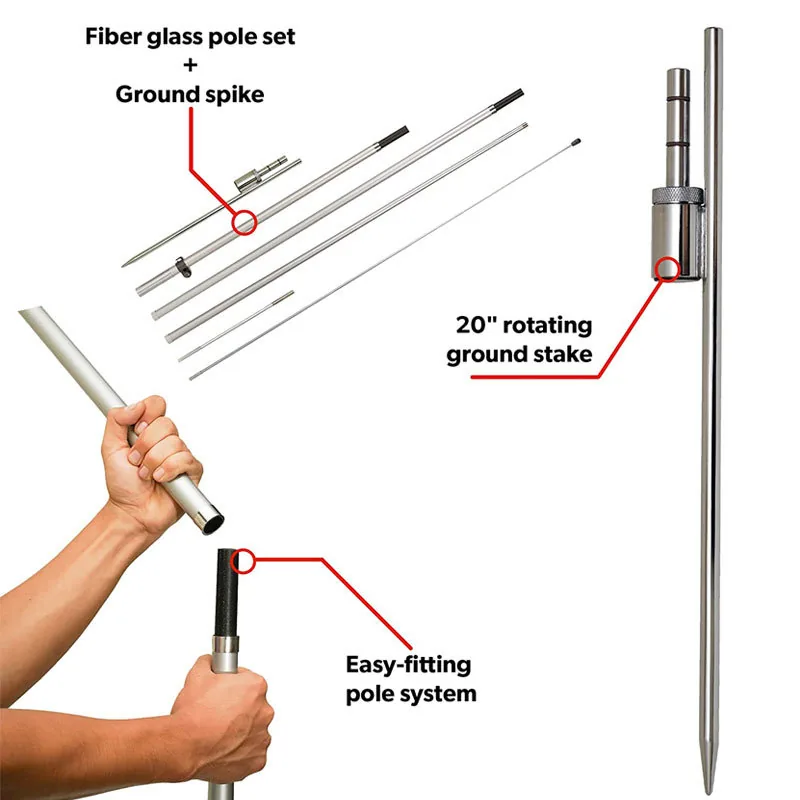
Poles are sectional, and material choice changes both the unit cost and the freight:
- Fibreglass — the volume default. Flexible, wind-friendly, economical. Standard on most sets we ship.
- Aluminium — straighter and stiffer with an anodised finish; heavier, so it costs more to make and to freight.
- Carbon — the lightest and stiffest option, at a premium that only makes sense for premium retail or frequent event use.
The trade-offs are laid out properly in our flag pole material comparison.
Factor 5: the base
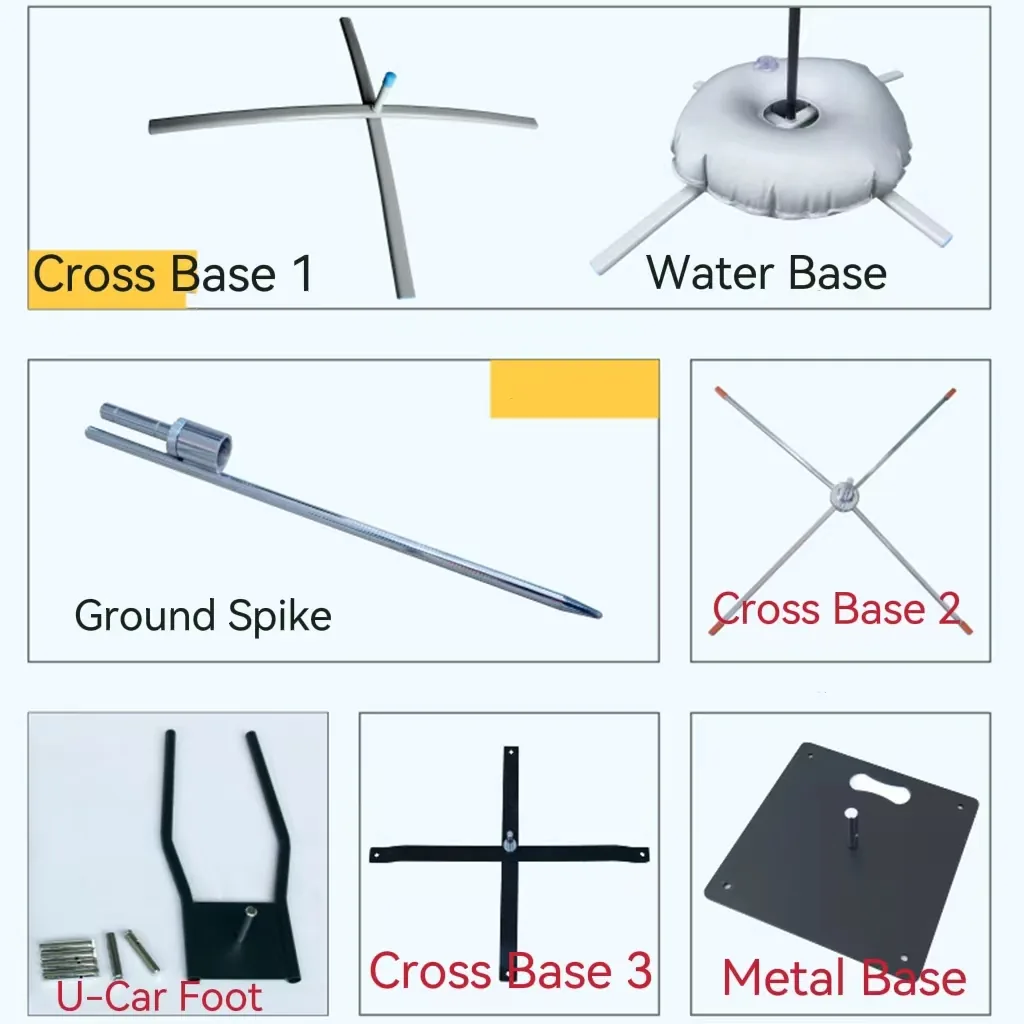
The base is where unscrupulous quotes save money, because it is the component the customer sees least in a product photo. A bare cross base is the cheapest way to make a set stand up — and the fastest way to generate a wind claim on a 4.5 m flag.
Our pairing table by pole length and surface is in the flag base types guide. As a rule: cross base to 3.4 m, filled tank from 4.5 m, spike only in soil.
Volume and freight: where unit cost collapses
Poles are bulky but light, so at container volume the freight per set becomes almost noise. Real numbers from our 4.5 m pole, TX-FP45:
| Item | Value |
|---|---|
| Poles per export carton | 35 pcs |
| Carton volume | 0.056 CBM (120 × 25 × 18.5 cm) |
| Gross weight per carton | 22 kg |
| 20GP container | ~500 cartons ≈ 17,500 poles |
At MOQ 100 pcs you pay for a slice of one carton; at 5,000 pcs you are filling pallets and the per-unit freight falls off a cliff. That is the structural reason B2B pricing starts at 100 pieces — see our MOQ and sampling FAQ.
The hidden costs buyers forget
- Artwork — print-ready vector artwork is on you; redrawing a low-res logo is a real cost.
- Samples — a printed sample ships in 7 days; sample cost is usually deducted from the bulk order.
- Spares — bodies wear before poles. Order 10% extra bodies, not extra poles.
- Duty and last-mile — FOB quotes exclude both. Ask for DDP if you want a landed number.
- Reprints — a second flag body for the same pole is far cheaper than a second full set. Design the programme that way from the start.
What to send for a quote in one email
Flag size and shape · quantity per size · fabric weight · print sides · pole material · base type · destination port. That is seven lines, and it gets an FOB quote with packing data back within 12 working hours — send it here.
FAQ
How much does a custom beach flag cost?
It depends on the five factors above — there is no honest single number. A 2.8 m fibreglass kit with a water bag is a fraction of a 5.6 m double-sided aluminium set with a filled tank. Send a spec and quantity and you will have a real FOB figure the same day.
Why do suppliers quote such different prices for the same flag?
Because "the same flag" rarely is. Fabric weight, print sides, base spec and pole material are where cheap quotes cut. Compare quotes line by line, not bottom line.
Is the sample cost extra?
A printed sample ships in 7 days and its cost is typically deducted from the bulk order it confirms. It exists to protect both sides before a container is committed.
What quantity gets the best unit price?
The steps are at 100, 500, 1,000 and 5,000 pieces per design. Container-scale orders change the freight economics entirely.
Does the price include the base?
Only if it says so. Always confirm the quote lists flag body, pole and base as separate lines — that is how you spot where a "cheap" set has been stripped down.